15 essential safety documents every workplace needs
The safety documents most workplaces need, from SWMS and risk assessments to registers and emergency plans, and where a small business should start.
هذا المقال متوفر بالإنجليزية حاليًا.

Most workplaces need a core set of safety documents: a safe work method statement (SWMS) for high-risk construction work, risk assessments, a safety management plan, policies and procedures, checklists, an emergency plan, incident reports and a risk register. Together they show what the risks are, how you control them and who is responsible. If you're just starting, five documents cover the essentials. The rest can follow as your work grows.
This guide lists fifteen documents, what each one is for, and where to start if you have a small business.
Why documents matter
Under the WHS laws, your business must identify hazards, manage the risks and keep workers safe so far as is reasonably practicable. Documents are how you show that you did. They also keep knowledge in the business, so a new supervisor or a relief worker can see how a task is meant to be done, rather than relying on memory.
Documents only help if they're accurate, used and kept current. A folder of out-of-date templates is a risk of its own.
The 15 documents
1. Safe work method statement (SWMS)
A SWMS sets out how a high-risk construction task will be done safely. It identifies the work, the hazards and risks, the controls, and how those controls will be put in place, monitored and reviewed.
For high-risk construction work, a SWMS is a legal requirement. It must be prepared before the work starts (regulation 299 of the model WHS Regulations), and the work must follow it. A SWMS is a living document: revise it when the method changes, when an incident happens, or when a new hazard appears. Many businesses pair their SWMS with specific procedures for tasks such as asbestos removal, demolition or work at heights.
Our guide to what a SWMS must include sets out the detail.
2. Risk assessment forms
A risk assessment identifies the hazards in a task or workplace, works out how likely and how serious the harm could be, and sets the controls. Use a form that records the hazard, the risk rating before and after controls, and who is responsible for each control.
Risk assessments feed into the SWMS, SOPs and risk register, so keep them consistent. Examples include a chemical risk assessment form and a road vehicle risk assessment form.
3. Safety management system or manual
A safety management system (SMS) sets out how you manage health and safety across the business. It covers the structure, responsibilities, policies, procedures and how performance is checked. The manual is the document that describes it, and it should be written for your business, not copied from someone else's.
Industry templates can give you a starting structure. Examples include an ISO 45001 construction OHS management system and an environmental construction management system.
4. Job safety analysis (JSA)
A JSA breaks a job into steps, identifies the hazards in each step and sets the control for each one. It's useful for routine tasks that don't meet the high-risk construction threshold, and for non-routine jobs that need a plan.
Involve the people who do the job when you write a JSA. They know where the steps go wrong, and the JSA is more likely to be followed when they helped build it. Our guide to SWMS vs JSA explains which one to use.
5. Safety policies and procedures
A policy is a statement from management about the importance of health and safety, and what the business commits to. A procedure sets out the steps people follow to meet that commitment, such as how to report an incident or how to request a permit.
Keep the policy short and signed by the person in charge. Examples include the WHS policy and the personal protective equipment (PPE) policy.
6. Safety checklists
Checklists help people check the things that matter before and during a task. Use them for pre-start checks, site inspections and audits. Good checklists focus on specific risks in the work area, such as:
- Clutter, trip hazards and clear access
- Electrical equipment, leads and power tools, inspected for damage
- Current PPE, and whether people are wearing it
- Emergency equipment and exits, and whether they're clear
- Whether only authorised people are using the equipment
Examples include a construction site inspection daily checklist and an electrical safety audit checklist for construction sites.
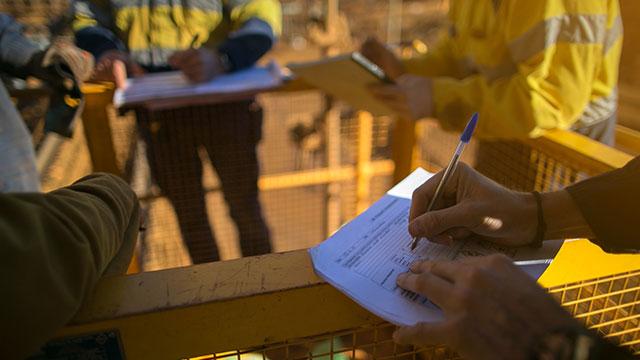
7. Worker and contractor handbooks
A handbook gives workers and contractors the site rules, hazards, permits, controls and reporting steps in one place. It helps you meet your duty to inform, and it gives people a way to raise unsafe conditions.
Handbooks are usually specific to a business or a site, but general construction handbooks are available as a starting point. Give every worker and contractor a copy at induction, and keep a record that they received it.
8. Site-specific safety management plan
A site safety management plan sets out the responsibilities, timelines and processes for a particular site. It covers the hazards of the work, who manages them and how compliance is monitored. It should name the high-risk activities on the site, such as asbestos, confined spaces or chemicals.
On a construction project, the principal contractor's WHS management plan must include arrangements for collecting, assessing, monitoring and reviewing SWMS (regulation 309). Subcontractors need to fit their own plans and SWMS into that structure. See the construction management plan and the chemicals and dangerous goods management plan for examples.
9. Safe operating procedures (SOPs)
An SOP, sometimes called a safe work procedure, is a set of specific steps for a task that could cause harm if done wrong. It covers the safe sequence of steps, the controls and the equipment to use. SOPs are most useful for tasks you do often, and for hazardous materials or machinery.
Write SOPs with the people who do the task, and check them against what actually happens on the job. Browse our SOP templates or see the chemical safety SOP for an example.
10. Risk register
A risk register lists every risk the business faces, how likely and serious each one is, the controls in place, and who owns it. It covers more than the job site: health and safety, environmental, financial and operational risks all belong in one place.
Review the register on a set schedule, and after any incident or change. An electrical equipment register and a risk register are good starting points.
11. Emergency response plan
An emergency response plan says what people do in a fire, explosion, spill, medical emergency or other emergency. It covers evacuation routes, assembly points, who calls emergency services and who checks everyone is out. Plans should match your building and business. A plan for a warehouse is different from one for a childcare centre or a construction site.
Test the plan with drills, and update it after changes to the building, the layout or the work. See the emergency response plan and the electrical emergency response plan.
12. Incident and investigation report
An incident report records what happened, who was involved, the immediate actions and the facts. An investigation goes further to find the causes and the fixes. The report is a factual record, not a blame sheet. Without one, you can't tell what went wrong, and the same problem is likely to happen again.
Use an incident report form for every incident, and a workplace violence report form where aggression is involved. Some incidents must be reported to the regulator. Our guide to notifiable incidents explains which ones.
13. Toolbox talk record
A toolbox talk is a short safety discussion at the start of a shift or task, on one specific topic such as PPE, a new machine or a recent near miss. Record who attended, what was covered and any actions. The record shows the crew was briefed, and it gives you a list of topics you've already covered.
Use the meeting and toolbox talk record to keep these consistent.
14. Near-miss reports
A near miss is an event that could have caused harm but didn't. A load that nearly fell, or a guard found loose, is a warning. A near-miss report captures what happened and why it nearly became an injury, so you can fix the cause before someone is hurt.
Make reporting quick and easy, and respond to every report. If people see nothing changes, they stop reporting.
15. Quality management system (QMS)
A quality management system sets out how you plan, control and improve the quality of your products or services. It covers procedures, standards, records and checks. If you're certified or working to AS/NZS ISO 9001:2016, the QMS is the set of documents that shows how you meet it. A QMS and plan is a useful starting structure.
Where to start if you're a small business
If the list feels long, start with five documents. These cover the basics for most small businesses:
- A SWMS for any high-risk construction work you do
- SOPs for the tasks you do most often
- A management manual or ISO management system manual, which ties the rest together
- A safety management plan for your business or your current site
- A safety policy, signed by the owner or manager
Then add the risk register, the emergency plan, the incident report form and a toolbox talk record. The rest can follow as your work grows.
Keep the documents in one place, and make sure your team can find the current version. Old copies on a phone or in a ute are a common problem.
Common questions
What is the most important safety document? For high-risk construction work, the SWMS. For other businesses, it's usually the risk register, because it shows what you know about your risks and how you control them.
Do I need all 15 documents? No. Your business should have the documents that match the risks you have. A low-risk office doesn't need a SWMS, and a construction firm needs more than an office does.
How often should safety documents be reviewed? Review them on a set schedule, usually once a year, and whenever the work, the site, the equipment or the law changes. Review them after any incident as well.
Where do I find templates? Our template library has documents for most industries. Adapt them to your business rather than using them as they are.
This is general information, not legal advice. Check the current law with your WHS regulator.
مكتبة النماذج
طبّق ذلك عمليًا مع نموذج SWMS جاهز.
تصفّح نماذج SWMS المكتوبة للحِرف في أستراليا. عاين أيًّا منها مجانًا، ثم عدّل واحدًا ليناسب مهمتك في دقائق.
نماذج لهذا العمل
- سياسةWHS Policy
- خطة إدارةEmergency Response Plan
- نموذج تعبئة أو سجل أو قائمة تحققMeeting and Toolbox Talk Record
- نموذج تعبئة أو سجل أو قائمة تحققIncident Report Form
أدلة ذات صلة

إدارة السلامة
What does OHSE stand for? Meaning, basics and how to start
OHSE stands for occupational health, safety and environment. Learn what it covers, how it compares with WHS and OHS, and how to set up an OHSE system.
إدارة السلامة
Safe operating procedure vs standard operating procedure
Safe operating procedure vs standard operating procedure: what each means, when you need which, how they differ from SWMS and JSAs, and what a good SOP holds.

إدارة السلامة
OHS management system for business services in Australia
How an OHS management system works for offices and business services, what your WHS duties require, how AS/NZS ISO 45001 fits in, and the steps to build one.