Air conditioning installation: safe work practices
Safe air conditioning installation: the falls, electrical, refrigerant and heat hazards to control, the licences needed and a checklist for each job.
Hiện bài viết này chỉ có bằng tiếng Anh.
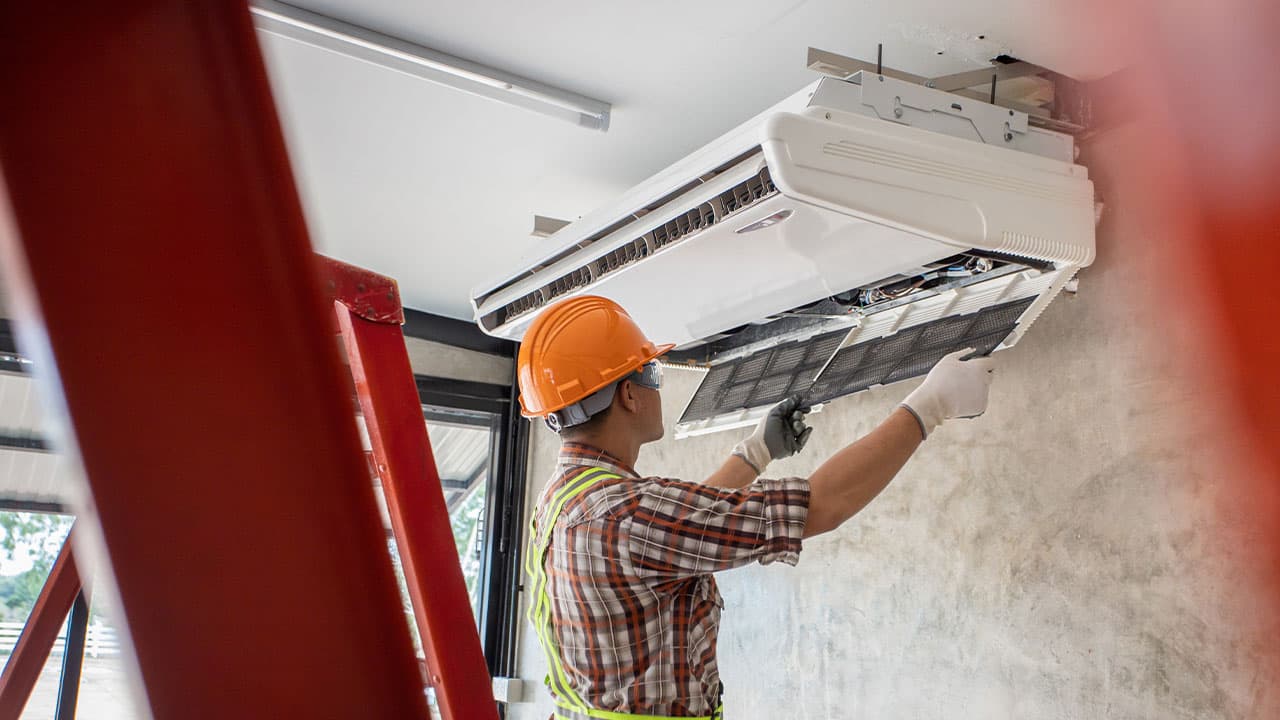
Safe air conditioning installation means finding the hazards before anyone climbs a ladder or opens a refrigerant line, then controlling them in order: remove the hazard where you can, isolate or engineer it, and rely on procedures and PPE last. The main risks are falls from roofs and ladders, live electrical work, refrigerant exposure, heat and manual handling. Electrical and refrigerant work also need the right licence.
This guide walks through the job from site check to handover, with the hazards, controls and licences installers need.
What an installation involves
A split-system or ducted install usually follows the same steps. Each one brings its own risks, so plan for all of them before the crew arrives:
- Site check: confirm where the indoor and outdoor units go, the access route, the roof or wall condition, and any services in the wall or ceiling.
- Indoor unit: mount the unit and, for ducted systems, connect the ductwork.
- Outdoor unit: set the unit on a level pad or brackets, with clear airflow and room for service.
- Refrigerant lines and electrical: run the lines, make the connections and wire the isolator and supply, which must be done by licensed people.
- Commissioning: pressure test, evacuate, charge and check airflow and performance.
- Clean-up and handover: remove waste, dispose of old equipment properly and walk the customer through operation and maintenance.
The main hazards
Falls from roofs, ladders and platforms
Outdoor units are often installed on roofs, balconies or elevated platforms. A fall of more than 2 metres makes the job high-risk construction work under the model Regulations, so a safe work method statement (SWMS) is needed before the work starts (regulation 299). Controls include:
- a fall-prevention system such as edge protection or a guardrail, before the fall-arrest option;
- a harness with a lanyard anchored to a rated point, where the other controls can't remove the fall;
- a stable ladder, tied off and set at the right angle, with a second person holding the base where it's safe to do so;
- no tools or units left at the edge where they could fall on people below.
See our guide to preventing falls from heights for more on the order of controls.
Live electrical work
Air conditioning units run on dedicated circuits, often at high current. Compressors and fan motors can keep a charge after power is off. Before any electrical work:
- Isolate the circuit at the switchboard and lock or tag the isolator.
- Test that the circuit is dead with a tested tester before you touch the conductors.
- Check the supply and earthing match the unit's requirements and the installation drawing.
- Keep the isolator in view or locked off until the job is finished.
Electrical work must follow AS/NZS 3000 (the Wiring Rules) and be done by someone with the electrical licence your state or territory requires. The electricity hazard page covers the controls in more detail.
Refrigerant
Refrigerants can cause frostbite from liquid contact and can harm people in a confined space. Some are also harmful to the environment, so leaks and disposal are regulated.
- Work with refrigerant only if you hold the Refrigerant Handling Licence from the Australian Refrigeration Council.
- Wear gloves and eye protection when connecting or disconnecting lines.
- Work in ventilated areas, and don't vent refrigerant to the air.
- Recover refrigerant to suitable cylinders and label them. Don't store cylinders in sunlight or near heat.
Heat
Roof and plant-room work can reach dangerous temperatures, especially in summer. Heat stress is common. Plan shade, water, rest breaks and cool-down areas, and watch for signs of heat illness in each other. The heat stress hazard page lists the controls.
Manual handling
Outdoor units, indoor cassettes and copper pipe rolls are heavy and awkward. Use a trolley, team lift or mechanical aid for heavy items, and plan the route before you lift.
Before the job: plan it
Good planning removes most of the surprises:
- Write the SWMS before the work starts. High-risk construction work needs a SWMS that describes the hazards, the controls and how they will be checked (regulation 299). Our air conditioning installation SWMS is a starting point, but it has to be checked against the actual roof, access and services.
- Check if the job is high-risk. Use the Do I need a SWMS? checker if you're not sure.
- Walk the site. Look for overhead power lines, unstable roofing, hidden wiring, gas lines and other trades.
- Confirm the equipment. Check the manufacturer's instructions and the lifting plan for heavy units.
- Brief the crew. Everyone should know the controls, the isolation point and the emergency plan before starting.
Safe work practices on the job
- Isolate and test before any electrical or refrigerant work, and tag the isolator.
- Follow the manufacturer's instructions for mounting, clearances and commissioning.
- Keep a clear work area and remove tools from edges and ladders.
- Use PPE for the task: gloves, eye protection, safety boots, and a harness where needed.
- Report hazards and near misses straight away, and stop work until they're controlled.
- Keep a record of refrigerant recovered and the equipment serviced.
Controls at a glance
| Hazard | Main controls | Licence or rule |
|---|---|---|
| Falls from roofs and ladders | Edge protection or guardrails first, then harness systems, secured ladders | High-risk construction work needs a SWMS (reg 299) |
| Live electrical work | Isolate, lock off, test dead, check earthing | Electrical licence for your state or territory; AS/NZS 3000 |
| Refrigerant exposure and release | Ventilation, gloves and eye protection, recovery to labelled cylinders | Refrigerant Handling Licence |
| Heat stress | Shade, water, rest breaks, timing of roof work | WHS duty to manage the risk |
| Manual handling | Trolleys, team lifts, planned route | WHS duty to manage the risk |
Licences and standards
- Refrigerant Handling Licence: anyone who works with refrigerant needs one, whatever their main trade. The Australian Refrigeration Council issues it.
- Electrical licence: the licence type and name depend on your state or territory. Check with your state regulator before you do any electrical work.
- AS/NZS 3000 (the Wiring Rules): the standard for electrical installations in Australia.
- National Construction Code: the NCC sets energy-efficiency and ventilation requirements that affect how units are sized and fitted.
Commonwealth laws also control refrigerant handling and disposal. Check the Australian Refrigeration Council's guidance for what you need to do.
Emergencies
Have an emergency plan that covers falls, electric shock, refrigerant exposure and heat illness. Make sure:
- someone on site holds current first aid training and a first aid kit is available;
- everyone knows how to shut off the supply at the switchboard;
- there is a rescue plan for a fall, and nobody moves a person who may have a spinal injury unless they are in immediate danger;
- you call 000 for serious injuries, and the crew knows the site address to give.
Our guide to emergency response plans explains how to write one.
How SafetyDocs helps
SafetyDocs has 1,250+ expert-written templates, including an air conditioning SWMS and a refrigerant gas SWMS. The job, client and site details fill themselves in, so you spend your time on the controls rather than the paperwork. Builders can comment on the exact line and approve the document before work starts. Workers sign on any phone from a link or QR code, with no app or account, and any change sends everyone who signed back to sign the new version.
Common questions
Do I need a SWMS to install an air conditioning unit? You need one if the work is high-risk construction work, such as work where there is a risk of a fall of more than 2 metres. The Do I need a SWMS? checker in our template library helps you find out.
Can an apprentice work with refrigerant? Check the Australian Refrigeration Council's guidance on who needs a Refrigerant Handling Licence before anyone handles refrigerant, and make sure training and supervision cover the job.
What if we only install the indoor unit? The hazards are smaller but still real. Electrical work and any refrigerant connection still need the right licences, and falls from ladders still need controls.
Who keeps the SWMS up to date? The business doing the work. Review it when the controls change, when the site changes or when a new hazard is found.
This is general information, not legal advice. Check the current law with your WHS regulator.
Thư viện mẫu
Áp dụng ngay với một SWMS soạn sẵn.
Xem các mẫu SWMS viết cho các ngành nghề ở Úc. Xem trước miễn phí bất kỳ mẫu nào, rồi điều chỉnh cho công việc của bạn trong vài phút.
Mẫu cho công việc này
- Bản mô tả phương pháp làm việc an toàn (SWMS)EWP, Boom, Cherry Picker and Scissor Lift
- Bản mô tả phương pháp làm việc an toàn (SWMS)Manual Handling
- Bản mô tả phương pháp làm việc an toàn (SWMS)Air Conditioning Service and Repairs
- Bản mô tả phương pháp làm việc an toàn (SWMS)Cable Ladder Tray-Conduit Installation
Hướng dẫn liên quan
Xây dựng
What is an ITP in construction? Inspection and test plans
ITP stands for inspection and test plan. Learn what an ITP is in construction, what goes in one, how hold and witness points work, and how to write one.

Xây dựng
Top 10 safety forms every site supervisor should have
The 10 safety forms a site supervisor needs, from pre-start checks and inductions to incident reports and contractor sign-in, and what each one is for.
Xây dựng
What is a scaffold? Hazards, licences and installation rules
What a scaffold is, the types used in Australia, when a licence is needed, the main hazards, and the SWMS and inspection rules that apply.