Health and safety fundamentals for small businesses
The WHS duties every small business owner must meet, the documents and training to start with, and how to check the rules in your state or territory.
Health and safety fundamentals for a small business come down to a few duties you cannot hand to anyone else: keep the workplace safe, manage the risks, consult your workers, and give them the information, training and supervision they need. You meet those duties with a risk assessment, written procedures, induction and training, an easy way to report incidents, and regular reviews. The law applies to a small business in the same way it applies to a large one, so the question is how much detail your business needs.
If you are starting out, you do not need a large system on day one. You need to know your duties, know which law applies where you work, and put the basics in place before you take on your first worker.
Your WHS duties
Work health and safety (WHS) is the framework of laws that protects the health and safety of people at work. It is also called occupational health and safety (OHS) in some states. Under the model WHS Act, a person conducting a business or undertaking (PCBU) has a primary duty of care to workers and others at the workplace (section 19). If you run a small business with workers, you are a PCBU.
The main principles behind those duties are simple:
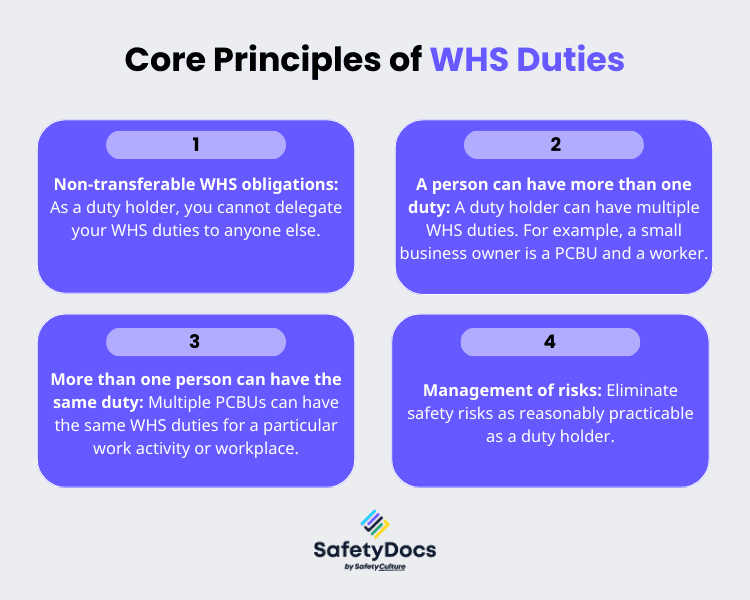
- You cannot transfer your duties. You can share work with a contractor or a labour hire firm, but you cannot hand over your responsibility for safety (section 14).
- One person can hold more than one duty. A small business owner who also does the work is both a PCBU and a worker.
- More than one person can hold the same duty. If you share a site with another business, you both have duties for the work on it.
- You must manage risks. Eliminate the risks you can, and where you cannot, minimise them so far as is reasonably practicable.
Workers have duties too. They must take reasonable care of their own health and safety and must follow your reasonable instructions (section 28). You must also consult workers on matters that affect their health and safety (section 47).
Which law applies to you
Most states and territories have adopted the model WHS laws, but enforcement is done by each state or territory regulator. Victoria is the main exception. Western Australia adopted the model laws from 31 March 2022. Check the law where your business operates, not just the one where you are based.
| Jurisdiction | Main WHS law | Notes |
|---|---|---|
| New South Wales | Work Health and Safety Act 2011 (NSW) | Model laws, with local rules such as food safety for hospitality |
| Queensland | Work Health and Safety Act 2011 (Qld) | Model laws, plus electrical safety rules for electrical work |
| South Australia | Work Health and Safety Act 2012 (SA) | Model laws |
| Western Australia | Work Health and Safety Act 2020 (WA) | Model laws adopted from 31 March 2022 |
| Tasmania | Work Health and Safety Act 2012 (Tas) | Model laws |
| Australian Capital Territory | Work Health and Safety Act 2011 (ACT) | Model laws |
| Northern Territory | Work Health and Safety (National Uniform Legislation) Act 2011 (NT) | Model laws |
| Victoria | Occupational Health and Safety Act 2004 (Vic) | Own law, with OHS Regulations 2017. Not the model laws |
Our state-by-state WHS guide sets out the regulator and the main regulations for each jurisdiction. Other laws apply alongside WHS, such as electrical safety, food safety and anti-discrimination law, so check those as well.
Start with five basics
You do not need to do everything at once. These five steps cover most of what a small business needs in its first year.
1. Assess your risks
Walk through your workplace and your work, and list what could hurt someone. Think about the tasks, the plant, the chemicals, the vehicles, the people and the environment. Rate each risk, decide how to control it, and write it down. A risk register keeps everything in one place, so you can see what you have dealt with and what is still open.
Control measures are more effective when you start at the top of the hierarchy: remove the hazard, then substitute, isolate, engineer, and only then rely on administrative controls and PPE.
2. Write down your procedures
Write short, clear procedures for the tasks that carry the most risk, and for emergencies. Keep them simple enough for a new starter to follow. A WHS policy sets out your commitment and how you will meet it. An emergency response plan covers the first steps when something goes wrong.
If you carry out high-risk construction work, you also need a safe work method statement (SWMS) before the work starts. Use the Do I need a SWMS? checker to see whether your work is on the list.
3. Induct and train your people
Give every new worker an induction before they start. Cover the site or workplace rules, the hazards they will face, the controls, the emergency procedures and who to report to. Use an induction checklist so you cover the same points each time.
Training is not a one-off. Refresh it when the work changes, when new equipment arrives, and after an incident. Supervision is part of the duty too. A new worker should not be left to work out the safe way on their own.
4. Make reporting easy
Workers need a simple way to report injuries, near misses and hazards. Use an incident report form and a hazard report form, and name the person who receives them. Act on each report, and tell the worker what you did.
5. Consult and review
Ask your workers what they think. In a small team, a short toolbox talk each week can do the job. Review your risk assessment, your procedures and your training when something changes, and at least once a year. Use what you learn from inspections and reports to improve the system.
The documents to start with
If you are starting from nothing, these are the documents most small businesses need first. You may not need all of them on day one.
- a WHS policy statement
- a risk register, or risk assessments for your main tasks
- safe operating procedures for hazardous tasks
- an emergency response plan, including evacuation
- incident and hazard report forms
- training and induction records
- maintenance logs for plant, vehicles and fire equipment
- a first aid checklist and a first aid worker register
- a regular compliance checklist for supervisors
SafetyDocs has templates for each of these, written by safety experts and ready to adapt to your business.
What is at stake
A workplace incident costs more than an injury. The direct costs include workers' compensation, medical expenses and legal fees or fines. The indirect costs are often larger: lost productivity while people are off or working less efficiently, the cost of replacing and training staff, and damage to your reputation with customers.
Good safety practice also helps a business in quieter ways. Workers who feel safe tend to stay longer, which matters for a small team that cannot afford high turnover. Clients and principal contractors often ask for evidence of your safety record before they hire you, and a clear system helps you answer those questions quickly.
Tips for small business owners
- Keep up with changes. Laws and guidance change. Subscribe to your regulator's updates, and check your procedures against them.
- Involve your workers. They see the hazards first. Ask them what is wrong, and act on what they tell you.
- Inspect before something goes wrong. Regular inspections and drills find problems while they are still cheap to fix.
- Get expert help where the work is specialised. Electrical work, food service and high-risk construction all have specific rules. An audit or a training session from a health and safety professional can find gaps you would miss.
- Keep records. Records of inspections, training, maintenance and incidents are your evidence that you did what you said you would do.
- Use simple digital tools if they help. A checklist app or a form that saves to a shared folder can save time, as long as the records stay accurate.
Model Code of Practice guidance can also help. The model code on managing psychosocial hazards at work, published in 2022, applies to businesses of any size and covers things like workload, bullying and role clarity.
Common questions
Do I need a written WHS policy? The law does not require a particular document for every business, but a written policy makes your duties clear to workers and to a regulator. It also gives you a single place to point to when you explain how you manage risk.
Is WHS only a concern if I have employees? No. If you run a business, you have duties to people who may be affected by your work, including contractors, visitors and members of the public. The number of workers changes how much you need to put in writing, not whether the duties apply.
What if I use contractors? You still have your duties. Share the work with the contractor, agree who does what, and check that the contractor is competent. You cannot transfer your duty to them.
What happens if I ignore the rules? Regulators can issue notices, fines and prosecution. Most states and territories now have industrial manslaughter offences, which apply to officers and businesses in the most serious cases. Check the penalties that apply in your state.
Read next
- Who is responsible for workplace safety and health?
- Risk assessment 101: what it is and how to get it right
- 10 WHS policies and procedures every workplace should have
How SafetyDocs helps
SafetyDocs gives small businesses templates for policies, procedures, forms and plans, written by safety experts since 2004. Job, client and site details fill themselves in, so each document starts with your own details. Workers sign free on any phone from a text, link or QR code, with no app or account. Documents go out in the crew's languages, with the English original kept as the record, and when a document changes, everyone who signed the old version is asked to sign the new one.
This is general information, not legal advice. Check the current law with your WHS regulator in the state or territory where you work.
Template library
Put it into practice with a ready-made SWMS.
Browse SWMS templates written for Australian trades. Preview any of them free, then tailor one to your job in minutes.
Templates for this work
Browse the template libraryRelated guides

Safety management
Creating an inclusive WHS plan for employees with disabilities
How to build a WHS plan that identifies barriers for workers with disabilities, consults them, sets adjustments and emergency support, and reviews the plan.

Safety management
HR documents every small business needs: a top 10 list
The ten HR documents most small businesses need, what each should cover, and the Australian laws that shape them, from employment agreements to vehicle use.

Safety management
How we build SafetyDocs, and how we look after you
How we design SafetyDocs: simple, seamless tools for the whole crew, built with the people who use them. Tell us what you'd like next.