ISO 9001 for beginners: a plain-English guide
What ISO 9001 is, what the standard asks of your business, how it relates to AS/NZS ISO 9001, the 2026 revision and how certification works.

ISO 9001 is the international standard for a quality management system (QMS). It sets out what a business needs to have in place to deliver consistent products and services, meet customer and regulatory requirements, and keep improving. It doesn't set product limits or safety rules. You don't have to be certified to it, but many customers and tender panels ask for certification.
This guide explains the standard in plain English: what a QMS is, what the clauses ask for, what changed in the 2026 revision, and how certification works in Australia.
What is ISO?
ISO, the International Organization for Standardization, is a network of national standards bodies that publishes standards on everything from packaging to information security. Standards Australia represents Australia in that network.
ISO's quality standards sit in the 9000 family:
- ISO 9000 explains the basic ideas and vocabulary.
- ISO 9001 sets out the requirements. It's the only one in the family that you can be certified against.
- ISO 9004 gives guidance on improving performance over the long term.
What is a quality management system?
A QMS is the set of connected processes, responsibilities and records a business uses to plan, deliver and check its work. Put simply, it answers four questions:
- Who is responsible for what?
- How is the work done, and to what standard?
- How do you check that it's done right?
- What happens when it isn't, and how do you stop it happening again?
A QMS doesn't need to be a large binder. A small business might run one with a short manual, a set of work instructions and a simple register for complaints and corrective actions.
The seven quality management principles
ISO 9001 rests on seven principles. You don't need to memorise them, but they're a useful test for any process you write:
- Customer focus: know what customers need and meet it.
- Leadership: managers set direction and show what quality looks like.
- Engagement of people: the people doing the work understand their role and are involved in improving it.
- Process approach: manage work as connected steps, not isolated tasks.
- Improvement: keep the system working and look for better ways to do things.
- Evidence-based decision making: decide using data, not hunches.
- Relationship management: work well with suppliers and other partners who affect your outcomes.
What the standard asks for
The 2015 edition is organised into clauses. Each one covers a part of running the system:
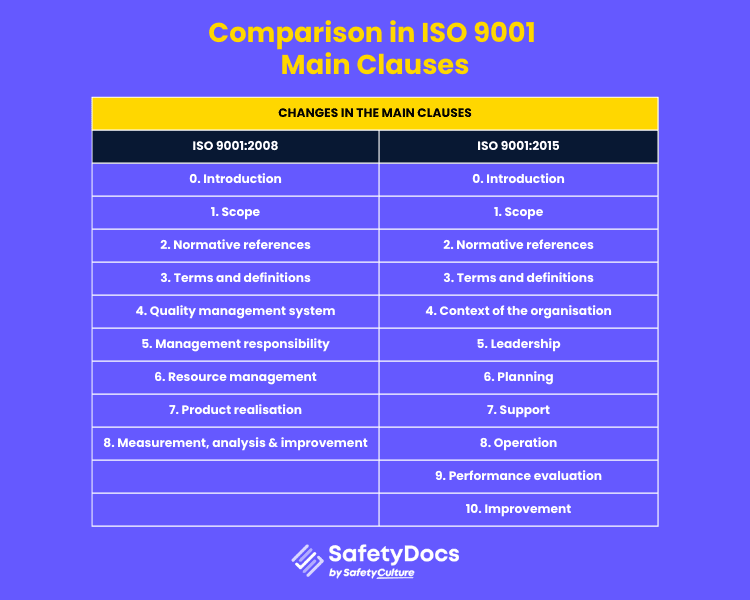
| Clause (2015 edition) | What it covers | What an auditor might ask to see |
|---|---|---|
| 4. Context of the organisation | Internal and external issues, and the scope of the QMS | A written scope and a list of what affects your business |
| 5. Leadership | Top management's commitment, policy and roles | A quality policy and evidence that managers review it |
| 6. Planning | Risks, opportunities and quality objectives | A risk register and measurable objectives |
| 7. Support | Resources, competence, awareness, communication and documented information | Training records and controlled documents |
| 8. Operation | Planning and control of the work, from customer requirements to delivery | Work instructions, job records and checks before delivery |
| 9. Performance evaluation | Monitoring, internal audits and management review | Audit reports and management review minutes |
| 10. Improvement | Non-conformities, corrective action and continual improvement | A corrective action log showing root causes and follow-up |
Three ideas run through the standard:
- Risk-based thinking. Identify what could stop you meeting your objectives, then act on the biggest risks. This was built in from the 2015 edition onward.
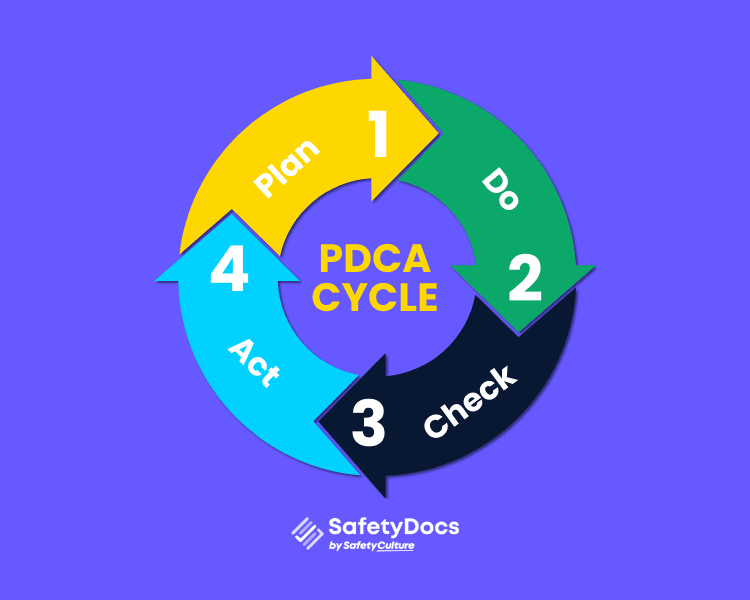
- The PDCA cycle. Plan, Do, Check, Act. Roughly, clauses 4 to 7 are the planning stage, clause 8 is doing the work, clause 9 is checking it, and clause 10 is acting on what you find.
- A common structure. Since 2015, ISO 9001 uses the same high-level structure as ISO 45001 and ISO 14001. If you run more than one system, the shared clauses let you combine them.
What changed from the 2008 edition
The 2015 edition made some changes that still matter:
- It no longer requires the six documented procedures that 2008 did (document control, records, internal audit, control of nonconforming product, corrective action and preventive action). You still need documented information where your processes need it, and many businesses keep those procedures because they're useful.
- It moved more responsibility onto top management, who must set direction and check the QMS, rather than delegating it to a quality manager.
- It added risk-based thinking and split performance evaluation and improvement into their own clauses.
What about the 2026 revision?
ISO published ISO 9001:2026 on 16 September 2026. It's the first full revision in more than a decade. The changes are described as evolutionary rather than a rewrite, and the structure stays familiar. Reported themes include a stronger focus on quality culture and ethical behaviour, opportunity-focused thinking, and climate change.
If you're certified to ISO 9001:2015, you have a three-year transition period. Certificates to the 2015 edition are expected to stop being valid around 30 September 2029, but check the exact date with your certification body. Standards Australia publishes the Australian version of the standard. Check there for when the AS/NZS adoption of the 2026 edition applies to you.
If you're starting now, ask your certification body which edition it will audit you against. It's sensible to build your system to the current version so you're not rewriting it during transition.
AS/NZS ISO 9001 explained
In Australia and New Zealand, ISO standards are adopted as AS/NZS standards. The AS/NZS ISO 9001:2016 standard is an adoption of ISO 9001:2015, not a different set of requirements. It's the same text, with the Australian and New Zealand prefix. You can buy it from the Standards Australia store.
Certification bodies accredited in Australia and New Zealand are assessed by the Joint Accreditation System of Australia and New Zealand (JAS-ANZ). When you choose a certifier, check that it holds JAS-ANZ accreditation for ISO 9001.
Why businesses use ISO 9001
ISO 9001 suits any business, whatever its size or industry. Most of the benefits come from making your work more consistent:
- Fewer mistakes and less rework. A written process means people do the job the same way each time, so there's less to fix.
- Happier customers. When you know what customers need and check you've delivered it, complaints fall and repeat work grows.
- Clearer responsibilities. Everyone knows who approves a quote, who checks a delivery and who follows up a complaint.
- Better chances with buyers. Some principal contractors, government buyers and large customers ask for certification before they add a supplier.
- Better use of your time. Once you've documented a process, you can train new staff faster and spot the steps that waste time.
For example, a small concreting business might write down how it checks each pour: the mix ticket, the slump test, the finishing and the sign-off. The first time a pour fails, the record shows which step was skipped. The next time, the check is built in.
Combining it with safety and environment systems
Many businesses run ISO 9001 alongside ISO 45001 for occupational health and safety and ISO 14001 for environmental management. Because the three share a structure, you can combine them into one integrated system with one set of policies, one audit program and one management review. Our guide to integrated management system documents shows what that paperwork looks like.
Keep one point clear: ISO 9001 certification doesn't meet your duties under work health and safety law. Those duties come from the WHS Act and Regulations. An ISO 45001 system can help you manage them, but it doesn't replace them.
How certification works
Certification is voluntary, and it's done by an independent certification body, not by the standard itself. The process usually looks like this:
- Decide why you're certifying. Work out whether a customer or tender requires it, and what it will cost in time and money.
- Do a gap analysis. Compare how you work now with what the standard requires.
- Build and run the system. You can write it yourself, start from a template or hire a consultant. Train your staff and run internal audits.
- Stage 1 audit. The auditor reviews your documents and checks you're ready for the on-site audit.
- Stage 2 audit. The auditor visits and checks that the system is followed and works.
- Surveillance and recertification. You'll have periodic surveillance audits, then a full recertification audit at the end of the three-year cycle.
Start with the documents you need
You don't need a full set of documents on day one. Start with the ones that show the system is working:
- a quality policy and a defined scope
- a register of risks and quality objectives
- procedures or work instructions for your key processes
- a non-conformance and corrective action log
- internal audit records and management review minutes
SafetyDocs has templates for each of these, including a quality management system, an AS/NZS ISO 9001:2016 internal audit checklist, a non-conformance report and an internal audit plan. Each one is a starting point. Edit it to match how your business actually works, because an auditor will check that the document matches what your staff do.
Common questions
Is ISO 9001 mandatory in Australia?
No. ISO 9001 certification is voluntary. Some customers, principal contractors and tender panels require it, so it may be a commercial requirement even though no law makes you certify.
Is AS/NZS ISO 9001 different from ISO 9001?
No. AS/NZS ISO 9001 is the Australian and New Zealand adoption of the international standard, with the same requirements.
Does ISO 9001 make me compliant with WHS law?
No. ISO 9001 is about quality. Your WHS duties come from the WHS Act and Regulations, and they apply whether or not you're certified. For safety management, look at ISO 45001 alongside your WHS obligations.
Do I have to switch to ISO 9001:2026 straight away?
Not immediately. The 2015 edition has a three-year transition period from the 2026 release. Ask your certification body when it will audit against the new edition, and build your system to the current version.
Template library
Put it into practice with a ready-made SWMS.
Browse SWMS templates written for Australian trades. Preview any of them free, then tailor one to your job in minutes.
Templates for this work
- Form, register or checklistAS/NZS ISO 9001:2016 Internal Audit Checklist
- Management planInternal Audit Plan
- Form, register or checklistNon-Conformance Report
- Management planQuality Management System
Related guides

Safety management
5 signs your quality management plan needs updating
Five warning signs that your quality management plan is out of date, what each one looks like on the job, and how to fix it before an audit does.

Safety management
Why Australian businesses need a quality management system
What a quality management system (QMS) is, why it keeps work consistent, and the four stages and core elements of AS/NZS ISO 9001:2016 explained.

Safety management
How we build SafetyDocs, and how we look after you
How we design SafetyDocs: simple, seamless tools for the whole crew, built with the people who use them. Tell us what you'd like next.