Take 5 safety: the five steps and when to use one
A Take 5 is a quick five-step hazard check before a task. Learn the steps, when to do one, how it differs from a JSA or SWMS, with a worked example.
6 min read
A Take 5 is a short personal hazard check a worker does just before starting a task: stop, look for hazards, assess the risk, put controls in place, then proceed. It takes about five minutes, which is where the name comes from, and it's usually recorded on a pocket-sized card or a phone.
If you searched "take 5 safety" or "what is a take 5", that's the short answer. This page goes through the five steps, when to do one, how a Take 5 differs from a JSA and a SWMS, and a worked example.
What is a Take 5?
A Take 5 is the last check before the work starts. A SWMS or a safe work procedure plans the job in advance; a Take 5 asks the person about to do it to look at the job in front of them, today, and confirm that the plan still fits.
It's sometimes called a step back, a stop and think, a pre-task check or a personal risk assessment. The idea is the same: things change between the planning and the doing. The weather turns, another trade starts work nearby, a piece of equipment is different from the one in the plan. A Take 5 catches that before someone gets hurt.
No WHS law requires a document called a Take 5. It's an industry practice that helps meet a legal duty under the model WHS Regulations: a PCBU must identify reasonably foreseeable hazards (regulation 34) and eliminate or minimise the risks so far as is reasonably practicable (regulation 35). Safe Work Australia's Code of Practice: How to manage work health and safety risks sets out the same cycle of identifying hazards, assessing risks, controlling them and reviewing the controls. A Take 5 is that cycle done in miniature, at the point of work.
The five steps of a Take 5
Card layouts differ between companies, but most use these five steps.
- Stop. Pause before you start. Think through the task: what you're about to do, in what order, and with what tools.
- Look. Walk around the work area and look for hazards: the ground, overhead, the equipment, the materials, other people and plant, the weather, ways in and out.
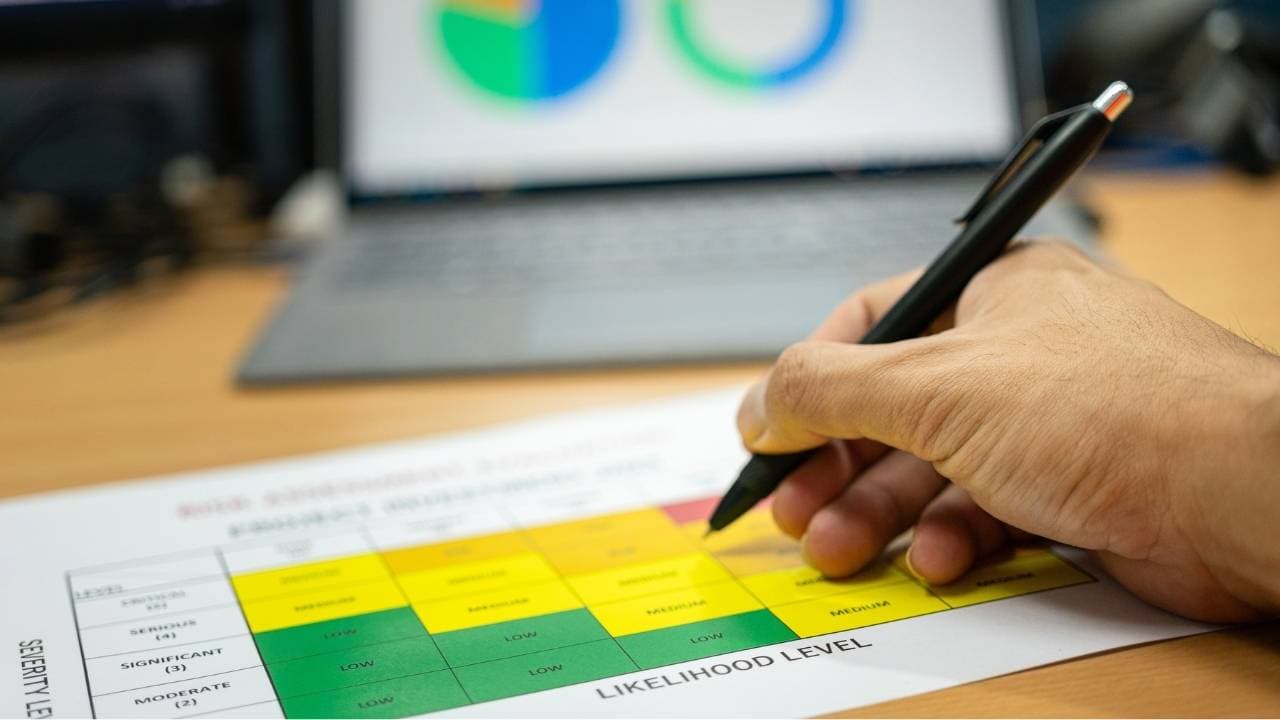
- Assess. For each hazard, ask how likely it is to hurt someone and how badly. Is this covered by the SWMS or procedure? Has anything changed?
- Control. Put controls in place before you start, starting with the most effective: remove the hazard if you can, then barriers and guards, then procedures, then PPE. If the risk can't be brought to an acceptable level, don't start: tell your supervisor.
- Proceed. Do the job safely, and keep watching. If conditions change, stop and do another Take 5.
Some versions call the last step "monitor" or "do the job safely". Our guide to hazard vs risk explains the difference between steps 2 and 3.
When should you do a Take 5?
Do one:
- at the start of each task, or each shift for repetitive work;
- when you arrive at a new site or a new area of a site;
- when conditions change: weather, lighting, another crew starting nearby, a different piece of equipment;
- after a break, when the work area may have changed while you were away;
- for non-routine or unfamiliar tasks; and
- whenever something doesn't feel right.
On many sites, the principal contractor's site rules require a Take 5 before work starts each day. Check the site's induction for what they expect and where completed cards go.
Take 5 vs JSA vs SWMS
The three are often confused, and they do different jobs. A Take 5 doesn't replace either of the others.
| Take 5 | JSA | SWMS | |
|---|---|---|---|
| What it is | A quick personal check at the point of work | A step-by-step analysis of one task's hazards and controls | A planned method for high-risk construction work |
| Who does it | The worker about to do the task | The supervisor and crew, before the task | The PCBU, with the workers, before the work starts |
| When | Right before the task, and when conditions change | Before a task that has no procedure, or is non-routine | Before high-risk construction work starts |
| How long | About five minutes | Tens of minutes to an hour | Prepared in advance, then reviewed |
| Legal status | Not required by the WHS laws | Not required by the WHS laws | Required for high-risk construction work (regulation 299) |
The usual pattern on a construction site is all three working together. The SWMS covers the high-risk activity as a whole, a JSA or JSEA breaks a tricky task within it into steps, and a Take 5 confirms on the day that the conditions match the plan. If the Take 5 finds a hazard the SWMS doesn't cover, stop, tell the supervisor and get the SWMS reviewed before work continues. For more on the first two, see the difference between a JSA and a SWMS.
A worked Take 5 example
A plumber arrives at a two-storey house under construction to fit off the upstairs bathroom. The job has a SWMS for working near the stair void, which hasn't got its balustrade yet.
Stop. The task: carry the vanity and tapware upstairs, fit them and test for leaks. About two hours.
Look. The temporary stair rail is in place, but the edge protection on the void has been taken down on one side by the electrician to run cables. The upstairs floor has offcuts and packaging lying around. It's raining and the stair treads are wet from boots.
Assess.
- Open edge on the stair void: a fall of more than 2 metres, which could be fatal. The SWMS assumes edge protection is in place, so the plan no longer fits.
- Wet treads while carrying a vanity: a slip, with a possible back or wrist injury.
- Offcuts on the floor: a trip near the void makes it worse.
Control.
- Don't start work near the void. Tell the site supervisor, who has the electrician reinstate the edge protection.
- Carry the vanity up with a second person, after drying the treads and putting down a mat at the bottom of the stairs.
- Clear the offcuts into a bin before bringing tools up.
Proceed. Once the edge protection is back, start the fit-off. Do another Take 5 if anyone takes the protection down again.
The plumber records the hazards, the controls and the time on a Take 5 pre-start checklist, which also asks whether the job involves high-risk construction work and whether the SWMS covers the hazards found.
Making Take 5s work, not just paperwork
The common complaint about Take 5s is that they become tick-and-flick: the same boxes ticked every day, filled in after the job, and filed unread. A few habits help:
- Keep it short. If the card takes longer than five minutes, people stop reading it.
- Ask open questions. "What has changed since yesterday?" gets a better answer than a list of tick boxes.
- Act on what's found. If workers report hazards on their Take 5 and nothing happens, they'll stop reporting them. Supervisors should read them and close out the issues.
- Back the decision to stop. A worker who stops a job because a Take 5 shows the risk isn't controlled has done exactly what the card is for.
- Look for patterns. The same hazard appearing on Take 5s week after week means a control is missing upstream, in the SWMS, the site setup or the procedure.
Common questions
Is a Take 5 a legal requirement? No WHS law names it. But PCBUs must identify hazards and control risks, and many principal contractors make a Take 5 a site rule. If the site requires it, you must do it.
What are the 5 steps of a Take 5? Stop, look, assess, control and proceed. Some cards word the steps differently, but they all follow the same cycle.
Who should fill in the Take 5? The person doing the task. It's a personal check, though a crew doing a task together can talk it through as a group.
Can a Take 5 replace a SWMS? No. If the work is high-risk construction work, a SWMS is required. A Take 5 checks on the day that the SWMS still fits the conditions.
How long should you keep Take 5 records? The WHS laws don't set a period for Take 5s. Keep them with the job records for as long as your site rules or client contract require, and long enough to spot recurring hazards.
This is general information, not legal advice. Check the current law with your WHS regulator.
Template library
Put it into practice with a ready-made SWMS.
Browse SWMS templates written for Australian trades. Preview any of them free, then tailor one to your job in minutes.