Traffic management plan vs traffic control plan: a guide
What a traffic management plan is, when you need one, and how it differs from a traffic control plan (TCP) for worksites and public roads.
Por ahora, este artículo está en inglés.

A traffic management plan (TMP) sets out how vehicles, powered mobile plant and pedestrians move around a workplace, and how you control the risks where they meet. A traffic control plan (TCP) is one part of it: the signs, cones, barriers and traffic controllers set up for a specific job, usually on or next to a public road. You need a TMP wherever vehicles and people share space at work, and a SWMS before any work on or next to a public road.
What is a traffic management plan?
A TMP is a written plan for managing traffic risks at a workplace or site. Traffic here means cars, trucks and powered mobile plant such as forklifts, loaders and excavators, along with pedestrians, which includes your workers and visitors.
Under the WHS Act, a person conducting a business or undertaking (PCBU) has a primary duty to make sure, so far as is reasonably practicable, that workers and other people aren't exposed to risks to their health and safety (section 19). Traffic is one of those risks. The laws don't name a "traffic management plan", but a written plan is the most practical way to identify, assess and control traffic risks, and to show that you have.
A TMP usually covers:
- the travel paths for vehicles, including entry and exit points
- pedestrian routes, and where they're kept apart from vehicles
- delivery, loading and unloading areas
- where and how often vehicles and people interact, and the control for each interaction
- routes away from the site, such as turning areas, ramps and dump points
- any special requirements, such as for mobile cranes or large trucks
- who is responsible for each control, and how it's reviewed
Safe Work Australia's traffic management guide for construction work describes the plan in much the same way.

What is a traffic control plan?
A TCP sets out the temporary traffic control for one job or one stage of a job. It shows where each sign, cone, barrier and traffic controller goes, and any detour, usually as a drawing with notes. Think of the TMP as the whole site and the TCP as the page for one task, such as closing a lane for a service connection.
The main reference for temporary traffic control on roads in Australia is AS 1742.3, the Manual of uniform traffic control devices, Part 3: Traffic control for works on roads. Road authorities set their own rules for work on their roads, such as approvals, permits and who may prepare the plan. Check with the council or state road authority before you start.
Some road features, such as give way signs, roundabouts, traffic lights and pedestrian crossings, are part of the road design. They aren't something you set up for the job, so they don't belong in a TCP.
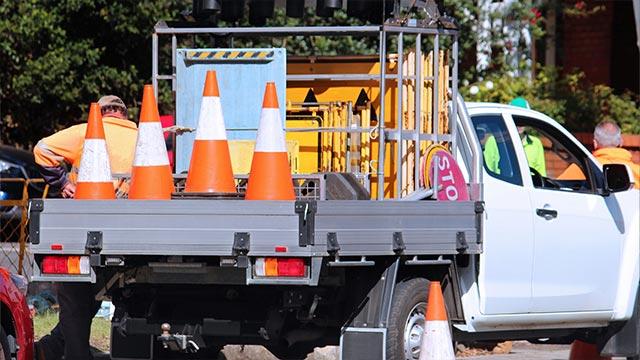
Traffic management plan vs traffic control plan
| Traffic management plan (TMP) | Traffic control plan (TCP) | |
|---|---|---|
| Scope | The whole workplace or site | One job, activity or stage of work |
| Covers | Routes, interaction points, loading areas, controls, responsibilities, training and review | The layout of signs, devices, barriers and traffic controllers, and any detour |
| Typical sites | Warehouses, construction sites, events, shopping centres and any site with vehicles and pedestrians | Work on or next to a public road, or a temporary road closure |
| Usually needed because of | The WHS duty to manage traffic risks, and the principal contractor's site rules | The road authority's approval, AS 1742.3 and the SWMS for the road work |
The TCP is one of the elements of a TMP. A good TMP explains how each TCP fits the site, so that when a crew moves to a new part of the job, they know which plan applies.
When is a traffic management plan required?
No single rule says "you must have a TMP". In practice you need one in these situations.
- Vehicles and people share a workplace. The section 19 duty applies, so you must identify and control the risk. A written TMP is how most sites show they've done it. Safe Work Australia's guides for events, warehousing and shopping centres take the same approach.
- You work on or next to a public road. Work on or adjacent to a road, or other traffic corridor, that's in use by traffic other than pedestrians is high-risk construction work (regulation 291). A SWMS must be prepared before the work starts (regulation 299), and it should refer to the TCP and the road authority's requirements. Our guide to what a SWMS must include covers the detail.
- You're on a construction project. The principal contractor's WHS management plan (regulation 309) sets out how the site's risks are managed. Your traffic arrangements should fit with it, not contradict it.
- A road authority or client asks for one. Councils and state road authorities can require a TMP or TCP, and an approval, before they let you work on their roads.
How to build a traffic management plan
- Map the site. Draw the buildings, gates, parking, delivery bays, blind corners, overhead structures and any public road next to the site. Walk it when traffic is busiest, not on a quiet morning. If powered mobile plant is part of the mix, our guide to managing plant risks in the workplace covers the plant side.
- List every interaction. Each point where a vehicle meets a person, or another vehicle, is a risk point. Note how often each happens and at what times. A reversing truck at the dock at 6 am is a different risk from the same truck at 2 pm.
- Choose controls in order. Start by removing the hazard: keep pedestrians out of vehicle areas, or move the loading bay. Then isolate people from vehicles with barriers and separate walkways. Then add engineering controls such as reversing cameras and proximity alarms. Use signs, spotters, training and high-visibility clothing last. The hierarchy of controls explains the order, and why PPE comes last.
- Name the people. Say who sets up and checks the controls each day, who directs traffic, and who can stop the work if a control fails.
- Brief the crew before work starts. Walk workers through the routes and the controls, and record it. A toolbox talk is a good place to do it.
- Review it when things change. Review the plan when a control isn't working, before a change at the workplace, when a new hazard appears, when consultation shows it's needed, or when a health and safety representative asks (regulation 38). Update the SWMS and TCP drawings with it.
A plan for a construction site might start from our construction traffic management plan, with a checklist to walk the site against. For a workplace with forklifts and delivery vehicles, the workplace traffic management plan is a better start.
How SafetyDocs helps
SafetyDocs has more than 1,250 expert-written templates, including traffic management plans, checklists and SWMS for work near traffic. The job, client and site details fill themselves in, so you only change what's different about your site. Builders can comment on the exact line before work starts and approve the document. Workers sign free on any phone from a text, a link or a QR code, with no app or account. When the plan changes, everyone who signed is asked to sign the new version. It helps you meet your duties, but it doesn't make you compliant on its own. You still have to check the plan against your site and the road authority's rules.
Common questions
Is a traffic management plan a legal requirement? The WHS laws don't name a traffic management plan, but they do require you to manage traffic risks, and a written plan is the usual way to show you have. Road authorities and principal contractors can add their own requirements on top.
Do I need a SWMS for work near a road? Yes, if the work is on or next to a road that's in use by traffic other than pedestrians. It's high-risk construction work, so a SWMS must be prepared before the work starts. The SWMS should refer to the traffic control plan.
Who prepares a traffic control plan? A competent person who knows AS 1742.3 and the road authority's rules. Who may prepare and approve a TCP differs between states and between road authorities, so check before you start.
Can I reuse a traffic control plan on another job? Only if the road, the layout and the hazards match. A plan for one road or one stage of work won't suit another, so check the drawing against the site each time.
This is general information, not legal advice. Check the current law with your WHS regulator.
Biblioteca de plantillas
Ponlo en práctica con un SWMS listo para usar.
Explora plantillas de SWMS escritas para los oficios de Australia. Mira la vista previa de cualquiera gratis y adapta una a tu obra en minutos.
Plantillas para este trabajo
- Plan de gestiónConstruction Traffic Management Plan
- Plan de gestiónWorkplace Traffic Management Plan
- Formulario, registro o lista de controlConstruction Traffic Management Plan Checklist
Guías relacionadas
Construcción
High-risk construction work in Australia: the 18 activities
The 18 kinds of high-risk construction work under the WHS Regulations, why each one needs a SWMS before work starts, and what to check first.
Construcción
Lift plans for cranes in Australia: when you need one
When a crane lift plan is needed in Australia, what it must cover for each lift, and how it fits with the SWMS for high-risk crane work.

Construcción
What is a construction site management plan? A practical guide
A construction site management plan sets out how a site runs safely day to day. What to include, how it fits the WHS management plan, and a checklist.