Hierarchy of controls: how to apply it at work
How to apply the hierarchy of controls: the order of elimination, substitution, isolation, engineering, administrative controls and PPE, with worksite examples.
本文目前只有英文版。
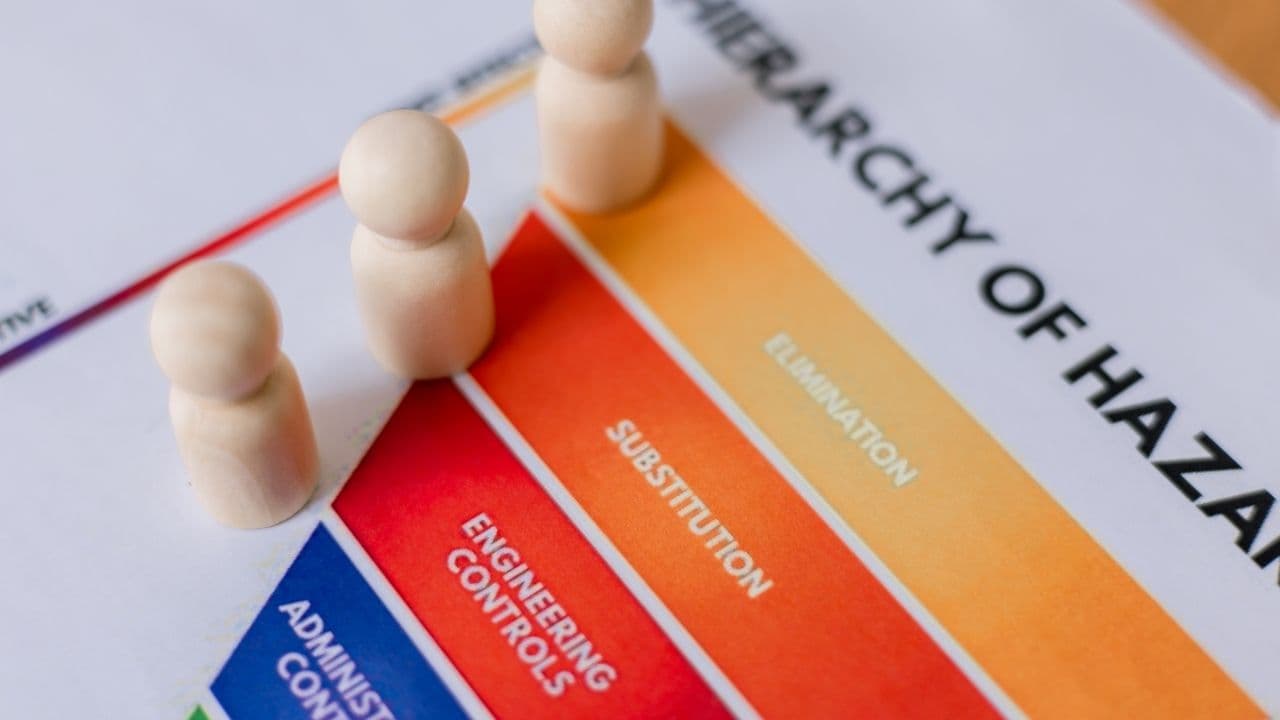
The hierarchy of controls is the order you work through when choosing how to deal with a risk: eliminate the hazard if you can, then substitute or isolate it, engineer it out, change how the work is done, and only then rely on personal protective equipment (PPE). You use the highest level that is reasonably practicable and move down only when the level above won't do the job. Under the model WHS Regulations, a risk must be eliminated where possible, and if it can't be, minimised in that order.
What does the law require?
Two regulations set the order.
- Eliminate first. The model WHS Regulations require a duty holder to eliminate risks to health and safety so far as is reasonably practicable. Only if that isn't reasonably practicable do they move to minimising the risk.
- Work down the list. If you must minimise, the hierarchy of control measures in regulation 36 applies. You substitute or isolate the hazard first, then use engineering controls. If a risk remains, you add administrative controls. Only then do you add PPE.
Your primary duty under the WHS Act is to ensure, so far as is reasonably practicable, that workers and others are not exposed to health and safety risks. The hierarchy is how you show you met that duty.
Reasonably practicable weighs how likely the harm is and how serious it could be against the cost, availability and suitability of the control. Cost alone isn't a reason to skip a higher level, and an inspector will ask why you did.
What are the levels of the hierarchy?
Level 1: Eliminate the hazard
Elimination removes the hazard completely. The risk goes with it, so this is always the strongest option.
- Stop a high-risk process, such as cutting timber on site when it can be pre-cut at the yard.
- Remove a hazardous product from the workplace and use a different method.
- Redesign the job so nobody needs to enter a confined space or work over a fall edge.
Level 2: Substitute or isolate
Substitution swaps a hazardous material or process for a less hazardous one. Isolation keeps the hazard away from the people exposed to it. Both reduce the risk without removing the hazard.
- Substitute a solvent-based product with a water-based one.
- Use a quieter machine, or a low-dust mixing method.
- Isolate a noisy compressor in its own enclosure, or fence off a mobile plant zone.
Level 3: Engineer the control
Engineering controls are physical changes to the workplace or equipment. They work without relying on someone remembering a rule, which is why they rank high.
- Fit a guard to a machine's moving parts.
- Use local exhaust ventilation at the point where fumes or dust are made.
- Install guardrails or edge protection on a roof or elevated platform, before anyone relies on a harness.
- Use a mechanical lifting aid or a vacuum lifter so a worker doesn't carry the load by hand.
A guard fitted at the design stage almost always costs less than retrofitting one after an injury.
Level 4: Administrative controls
Administrative controls change how the work is done. They include procedures, rosters, supervision, permits, training and signs. They are useful, but they depend on people following them every time, so they rank lower than engineering.
- A safe work method statement (SWMS) for a high-risk task.
- A roster that limits how long a worker spends in a noisy area or in heat.
- A permit-to-work system for hot work or confined space entry.
- Signs such as "Caution: hot surface" and clear traffic routes.
- Training and supervision for a new task, with a check that the worker can do it safely.
Level 5: PPE
PPE is worn by the worker. It protects only that person, and only while it's worn, fitted and in good condition. It doesn't reduce the hazard, so it's the last layer.
- Hearing protection where noise can't yet be reduced.
- Safety glasses for flying debris.
- Gloves for handling a chemical when no other option is practical.
- Respiratory protection for dust that engineering controls can't yet capture, fitted and tested for the worker.
Choosing PPE that fits and suits the job is a topic of its own. See PPE: how to choose, fit and look after it.
A worked example: cutting concrete on a site
Cutting concrete makes silica dust, a serious respiratory hazard. The table shows how each level applies. The top rows are the ones most people skip.
| Level | Control for concrete cutting |
|---|---|
| Eliminate | Use precast or prefabricated elements so less cutting is needed on site |
| Substitute or isolate | Pre-drill or core in a controlled area; cut in a fenced zone away from other trades |
| Engineer | Wet cutting to suppress dust, and on-tool extraction on the saw |
| Administrative | A written SWMS, work rotation, a clean-up plan, and a sign-off by the supervisor |
| PPE | A respirator fitted to the worker and tested for the job, as a backup layer |
The respirable crystalline silica hazard page lists more controls for this work. Engineered stone has been banned from use and supply since 1 July 2024, so for that product the control is simply not to use it.
How to work through the hierarchy
- Start at the top. Ask whether you can stop the task or the hazard completely. If the answer is yes, do it. You need a risk assessment first to know how serious the risk is.
- Move down only with a reason. If you can't eliminate the hazard, go to the next level and write down why the higher level isn't reasonably practicable.
- Combine controls. A single control is rarely enough. A quieter machine, a guard, a procedure and hearing protection together is a sound approach.
- Check the controls work. Look at each control on site, not just on paper. If workers find a way around it, redesign the control.
- Review when things change. A new plant item, a new product or a new crew sends you back to the hierarchy.
Record the decision
The hierarchy is only useful if the decision is written down. Record the hazard, the control chosen, the level it sits at, why higher levels weren't used, and who checks it. A risk register keeps those decisions in one place, so the next supervisor can see why a particular control exists.
The same applies to noise, manual tasks and environmental hazards. A plant and equipment register can record guards, isolation points and inspection dates, and a chemical register can hold the safety data sheets alongside the ventilation requirements.
Common mistakes
- Going straight to PPE. Gloves and goggles are cheap and fast, so they get chosen first. They shouldn't be the only control for a risk that has a higher-level fix.
- Relying on signs and rules alone. Administrative controls fail when nobody checks them. Pair them with supervision or an engineering control.
- Skipping the reasons. If you can't say why a higher level wasn't used, the decision isn't documented well enough.
- Never reviewing. Controls drift. A guard gets removed, a procedure is ignored, a new worker arrives. Check them regularly.
- Excluding the crew. The people doing the task know which controls are practical. Ask them before you choose.
Good control decisions come from layers, not luck. Work from the top down, write the reasons, and check that the controls are still doing their job.
Common questions
Why is PPE the last resort? PPE only protects the person wearing it, and only when it's fitted, worn and used correctly. The hazard is still there, so one missed step can cause an injury.
What is the difference between an engineering control and an administrative control? An engineering control changes the physical workplace or equipment, such as a machine guard. An administrative control changes how people work, such as a procedure, a roster or a permit.
Can I use PPE alone if it's cheaper? Not if a higher-level control is reasonably practicable. Cost is one factor in that judgement, but it doesn't remove the duty to eliminate or minimise the risk further.
Do I have to follow the hierarchy in order? You must start at elimination and move down only when the higher level isn't reasonably practicable. Combining controls is expected where one control isn't enough.
This is general information, not legal advice. Check the current law with your WHS regulator.
模板库
用一份现成的 SWMS付诸实践。
浏览为澳大利亚各工种编写的 SWMS 模板。任何模板都可免费预览,几分钟就能按你的工作改好。
适用于这项工作的模板
浏览模板库相关指南
风险管理
Hazard vs risk: what's the difference? With examples
A hazard is anything that could cause harm; a risk is the chance it will, and how bad the harm could be. See the difference with workplace examples.
风险管理
Reviewing risk controls: why it matters and how to do it
When and how to review risk controls: the WHS Regulation triggers, a practical check of each control on site, and how to record what you find.
风险管理
Risk assessment 101: what it is and how to get it right
What a risk assessment is, how it differs from a hazard, how to use a risk matrix, and the five steps to assess and control workplace risks.