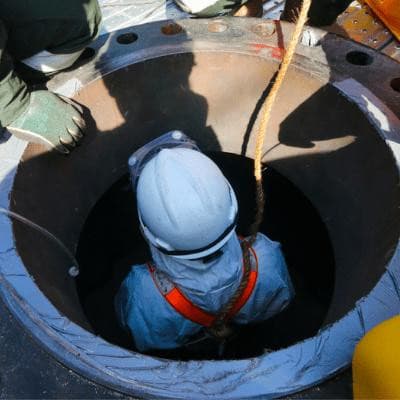
Blocked access and egress
Entries, exits and escape routes that are obstructed, too small or left unsecured, which trap people or hinder their rescue.
Also known as: Blocked entry and exit points, Blocked exits, Obstructed access, Restricted access and egress
How to control blocked access and egress
- Plan entry and exit points so they are large enough for workers, their equipment and a rescue using a stretcher or harness.
- Keep exits, escape routes and access ways clear of materials, waste, hoses and leads at all times.
- Secure hatches and doors so they cannot close or lock while people are inside, and barricade openings when unattended.
- Check emergency exits and escape routes at the start of each shift and after any change to the work area.
- Keep rescue equipment set up at the entry point, and confirm the rescue plan works for that opening.
Typical controls, most effective first. Your SWMS sets the controls for your own job and site.
Templates that cover Blocked access and egress
SWMS by trade
Hazards that come up alongside it
Legislation these templates cite
- Code of Practice: Confined spaces1 template
- Code of Practice: Construction work1 template
- Code of Practice: First aid in the workplace1 template
- Code of Practice: How to manage WHS risks1 template
- Code of Practice: Work environment and facilities1 template
- Compliance code: Confined spaces (Vic)1 template
- OHS Act 2004 (Vic)1 template
- OHS Regulations 2017 (Vic)1 template