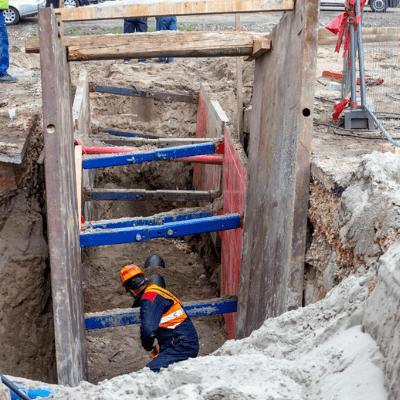
Crane and load collision
A crane, its boom or a suspended load striking another crane, a structure or people, often where cranes share airspace.
Por ahora, esta página está en inglés.
Charla de seguridad gratis sobre crane and load collision
También conocido como: Load collision, Crane collision
Cómo controlar: crane and load collision
- Plan crane positions and slewing paths so working radii don't overlap, or set a no-go zone for each crane where they must.
- Check for structures, scaffolds and power lines within the crane's working envelope before set-up.
- Use anti-collision systems or spotters to keep cranes, booms and loads apart where cranes share airspace.
- Agree a lift plan and a communication channel with other crane operators, doggers and spotters before lifting.
- Use tag lines to control load rotation, and keep people out from under and beside suspended loads.
- Stop lifting when visibility or wind reduces the operator's control of the load.
Controles habituales, del más eficaz al menos eficaz. Tu SWMS fija los controles para tu propio trabajo y tu obra.
Plantillas que cubren Crane and load collision





 Paquete ahorro · 35 plantillas


 +31
 Paquete ahorro · 49 plantillas+45
 Sistema · 156 documentos

 +152
 Paquete ahorro · 40 plantillas

 +36Paquete ahorro · 57 plantillas
 +53Sistema · 165 documentos
 +161Paquete ahorro · 32 plantillas
 +28
SWMS por oficio
Peligros que suelen aparecer junto a este
- Environmental contamination73 plantillas
- Manual tasks73 plantillas
- Mobile plant and vehicles73 plantillas
- Personal injury, property damage or environmental incident73 plantillas
- Plant roll-away or roll-over73 plantillas
- Slips, trips and falls73 plantillas
- Unauthorised access73 plantillas
- Adverse weather72 plantillas
Legislación que citan estas plantillas
- WHS Act 201158 plantillas
- WHS Regulations 201158 plantillas
- OHS Act 2004 (Vic)55 plantillas
- OHS Regulations 2017 (Vic)54 plantillas
- Code of Practice: Construction work50 plantillas
- Code of Practice: First aid in the workplace49 plantillas
- Code of Practice: How to manage WHS risks49 plantillas
- Code of Practice: Work environment and facilities49 plantillas